Table of Contents
ToggleVitamin D and B12 Deficiency: What You Should Know About Heart Health
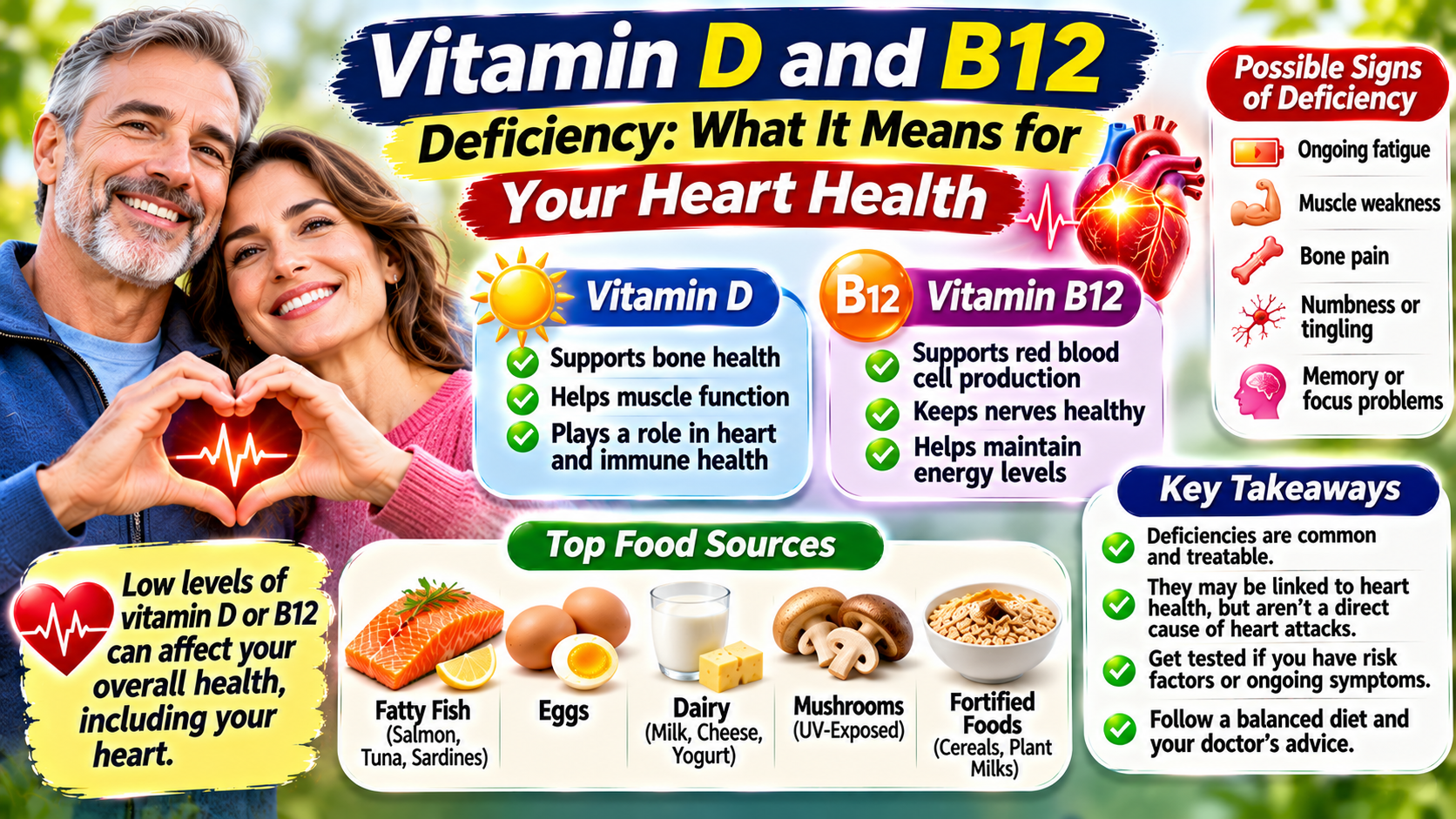
Vitamins play an important role in keeping your body functioning properly. Two nutrients that deserve particular attention are vitamin D and vitamin B12. Both are essential for normal health, and inadequate levels can lead to significant medical problems.
Vitamin D helps your body absorb calcium and maintain healthy bones and muscles. Vitamin B12 supports red blood cell production, DNA synthesis and normal nerve function.
Researchers have also investigated whether deficiencies in these vitamins are connected to cardiovascular disease. Some studies have found associations between low vitamin levels and a higher risk of heart problems. However, an important distinction exists between an association and a proven cause.
In this article, we explore how vitamin D and B12 deficiencies affect the body, their possible relationship with heart health, who may be at risk, how deficiencies are diagnosed and how to maintain healthy vitamin levels.
1. Why Are Vitamins Important for Heart Health?
Your heart is a muscular organ that continuously pumps blood throughout your body. It depends on a healthy cardiovascular system, adequate oxygen supply and normal muscle and nerve function.
Several vitamins and minerals contribute to these processes.
Vitamin D helps regulate calcium and phosphorus, which are important for bone health and normal muscle function.
Vitamin B12 supports the production of healthy red blood cells, which carry oxygen through the bloodstream. It also helps maintain the protective covering around nerves.
Other nutrients, including folate, vitamin B6, potassium and magnesium, have important roles in normal body function.
However, having adequate vitamin levels does not guarantee protection against heart disease. Cardiovascular health also depends on blood pressure, cholesterol, blood sugar, smoking status, physical activity, genetics and other factors.
2. Vitamin D Deficiency and Heart Health
Vitamin D is a fat-soluble vitamin that helps the body absorb calcium and maintain healthy bones.
Your body produces vitamin D when your skin is exposed to ultraviolet B (UVB) rays from sunlight. You can also obtain it from certain foods and supplements.
What happens when vitamin D levels are low?
Inadequate vitamin D can affect several functions in the body.
Severe or prolonged deficiency may cause:
- Reduced calcium absorption.
- Weak or poorly mineralised bones.
- Osteomalacia in adults.
- Rickets in children.
- Muscle weakness and bone pain.
Vitamin D also participates in biological processes involving inflammation, blood pressure regulation and blood vessel function.
This has led researchers to investigate whether low vitamin D levels contribute to cardiovascular disease.
Is vitamin D deficiency a direct cause of heart attacks?
This is an important question, and the scientific evidence needs to be interpreted carefully.
Observational studies have found that people with lower vitamin D levels sometimes have higher rates of cardiovascular disease.
However, this does not prove that vitamin D deficiency directly causes heart attacks.
People with low vitamin D may also have other health or lifestyle factors that increase cardiovascular risk.
Importantly, large clinical trials have not consistently shown that taking vitamin D supplements prevents heart attacks, strokes or cardiovascular deaths.
The NIH Office of Dietary Supplements notes that clinical trials have not confirmed the cardiovascular benefits suggested by observational research.
What this means: Correcting vitamin D deficiency is important for appropriate medical reasons, particularly bone and muscle health. But vitamin D supplements should not be taken as a substitute for established heart disease prevention measures.
Possible symptoms of vitamin D deficiency
Some people with low vitamin D have no obvious symptoms.
When deficiency becomes significant, possible symptoms include:
- Bone pain.
- Muscle weakness.
- Muscle aches.
- Difficulty climbing stairs.
- Difficulty getting up from a chair.
- Increased risk of fractures in severe cases.
Fatigue may also occur, but it is not specific to vitamin D deficiency.
3. Vitamin B12 Deficiency and Heart Health
Vitamin B12, also known as cobalamin, is essential for the formation of red blood cells, DNA synthesis and normal nervous system function.
Unlike vitamin D, the body cannot produce vitamin B12. It must be obtained through food or supplements.
Why is vitamin B12 important?
Vitamin B12 helps your body:
- Produce healthy red blood cells.
- Maintain normal nerve function.
- Support DNA production.
- Prevent certain types of anaemia.
- Maintain normal neurological function.
A prolonged deficiency can cause megaloblastic anaemia, a condition in which red blood cells become unusually large and do not function normally.
It can also cause nerve damage, sometimes even before anaemia becomes apparent.
Understanding vitamin B12 and homocysteine
One reason researchers have investigated vitamin B12 and heart health is its role in regulating an amino acid called homocysteine.
Your body uses vitamin B12, folate and vitamin B6 in metabolic pathways that help process homocysteine.
When vitamin B12 is inadequate, homocysteine levels may increase.
Higher homocysteine levels have been associated with cardiovascular disease in observational studies.
However, lowering homocysteine with B-vitamin supplements has not reliably reduced heart attacks or cardiovascular deaths in clinical trials.
Therefore, vitamin B12 deficiency should be diagnosed and treated for its established effects on blood and nerve health—not because taking extra B12 has been proven to prevent heart attacks.
Symptoms of vitamin B12 deficiency
Possible signs include:
- Persistent fatigue and weakness.
- Pale skin.
- Tingling or numbness in the hands and feet.
- Difficulty maintaining balance.
- Memory or concentration difficulties.
- A swollen or sore tongue.
- Shortness of breath when anaemia develops.
- Palpitations.
- Unexplained weight loss in some cases.
- Neurological changes.
These symptoms can have several causes. A blood test and medical evaluation are needed to identify vitamin B12 deficiency.
4. Can Vitamin D and B12 Deficiencies Occur Together?
Yes. A person can have both deficiencies at the same time.
For example, an older adult with a restricted diet, limited sunlight exposure and a digestive condition may be at risk of inadequate levels of both nutrients.
However, there is no established evidence that having both deficiencies automatically multiplies the risk of a heart attack.
Each deficiency should be assessed and treated according to its own causes and health consequences.
It is also important to investigate why deficiencies are occurring. Simply taking supplements without addressing an underlying absorption problem may not provide an adequate long-term solution.
5. Who Is at Greater Risk of Vitamin D Deficiency?
Certain groups have a higher likelihood of developing low vitamin D levels.
People who spend most of their time indoors
Office workers, night-shift employees and people with limited outdoor activity may receive less UVB exposure.
Older adults
The skin becomes less efficient at producing vitamin D with age. Older adults may also spend less time outdoors.
People with darker skin pigmentation
Melanin reduces the skin’s production of vitamin D from sunlight. People with darker skin may need more UVB exposure to produce similar amounts.
People with obesity
People with obesity are more likely to have lower circulating vitamin D levels.
People with digestive conditions
Coeliac disease, Crohn’s disease and other conditions involving fat malabsorption can affect vitamin D absorption.
People with kidney or liver disease
The liver and kidneys are involved in vitamin D metabolism. Certain chronic conditions can interfere with this process.
6. Who Is at Greater Risk of Vitamin B12 Deficiency?
Vitamin B12 deficiency can occur even when a person eats enough food, because absorption problems are another important cause.
Vegetarians and vegans
Natural vitamin B12 is found mainly in animal-derived foods.
People who avoid meat, fish, eggs and dairy products need reliable fortified foods or B12 supplements to meet their requirements.
Adults over 50
As people age, stomach acid production may decline, making it harder to release vitamin B12 from food.
Fortified foods and supplements contain B12 in a form that does not require the same release process.
People taking certain medications
Long-term use of certain medicines may affect B12 status.
Examples include:
- Metformin.
- Proton pump inhibitors such as omeprazole.
- H2-receptor blockers.
Do not stop prescribed medication. Ask your healthcare professional whether monitoring is appropriate.
People with digestive disorders
Conditions that affect the stomach or small intestine can interfere with vitamin B12 absorption.
Examples include:
- Coeliac disease.
- Crohn’s disease.
- Pernicious anaemia.
- Atrophic gastritis.
- Previous stomach or intestinal surgery.
People with a history of bariatric surgery
Some weight-loss surgeries can affect the body’s ability to absorb vitamin B12 and other nutrients. Long-term monitoring and supplementation may be necessary.
7. How Are Vitamin D and B12 Deficiencies Diagnosed?
Symptoms alone cannot confirm either deficiency.
Doctors use medical history, physical examination and appropriate laboratory tests.
Vitamin D blood test
The standard test is called 25-hydroxyvitamin D, or 25(OH)D.
It measures the main circulating form of vitamin D.
The NIH Office of Dietary Supplements provides these general interpretation ranges:
| 25(OH)D level | General interpretation |
|---|---|
| Below 12 ng/mL | Associated with vitamin D deficiency |
| 12 to below 20 ng/mL | Generally inadequate for some people |
| 20 ng/mL or above | Generally adequate for bone health in most healthy people |
| Above 50 ng/mL | May be associated with adverse effects, particularly at higher levels |
These are general reference points, not personalised treatment targets. Laboratory interpretation and individual medical needs may differ.
Routine vitamin D testing is not necessary for every healthy adult. Testing is more appropriate when there is a specific clinical reason.
Vitamin B12 blood test
A serum vitamin B12 test is commonly used to assess B12 status.
Most laboratories consider values below approximately 200–250 pg/mL to be low, although reference ranges vary.
When the result is borderline or does not match the clinical picture, doctors may request additional testing.
Methylmalonic acid (MMA): MMA levels can rise when vitamin B12 is insufficient. This can help clarify borderline results, although kidney function also affects MMA.
Homocysteine: Elevated levels can occur with B12 deficiency, but they are not specific because folate deficiency and kidney problems can also increase them.
Additional tests
Depending on the patient’s symptoms, a doctor may request:
- Complete blood count (CBC).
- Folate levels.
- Kidney function tests.
- Calcium levels.
- Other tests to investigate the cause of deficiency.
Do not order or interpret tests in isolation. A healthcare professional should assess the results in context.
8. Best Food Sources of Vitamin D
Food can contribute to maintaining adequate vitamin D intake.
Useful sources include:
Fatty fish
- Salmon.
- Sardines.
- Trout.
- Mackerel.
- Tuna.
Egg yolks
Egg yolks provide vitamin D, although the amount varies.
UV-exposed mushrooms
Certain mushrooms exposed to ultraviolet light contain vitamin D2.
Fortified foods
Some US food products are fortified with vitamin D, including:
- Milk.
- Selected plant-based milk alternatives.
- Breakfast cereals.
- Certain orange juices.
- Some yoghurts.
Always check the Nutrition Facts label because not every product is fortified.
9. Best Food Sources of Vitamin B12
Vitamin B12 is naturally present mainly in animal-derived foods.
Good sources include:
Fish and seafood
- Salmon.
- Tuna.
- Trout.
- Clams.
- Sardines.
Meat and poultry
- Beef.
- Chicken.
- Turkey.
- Beef liver.
Dairy products
- Milk.
- Yoghurt.
- Cheese.
Eggs
Eggs provide vitamin B12, although the amount is relatively modest.
Fortified foods
People following plant-based diets can obtain B12 from:
- Fortified breakfast cereals.
- Fortified nutritional yeast.
- Fortified plant-based milk.
- Other foods with added vitamin B12.
Not all nutritional yeast or plant-based products contain B12. Check the label.
People following a vegan diet should plan a reliable source of vitamin B12 through fortified foods or supplementation.
10. Should You Take Vitamin D and B12 Supplements?
Supplements can be useful when dietary intake is insufficient, absorption is impaired or a deficiency has been diagnosed.
However, taking high doses without a medical reason is not a good strategy.
Vitamin D supplements
Vitamin D supplements are available as vitamin D2 and vitamin D3.
Both can increase vitamin D levels, although D3 may raise levels more effectively in some circumstances.
For generally healthy adults, the US recommended daily intake is:
- Adults aged 19–70: 600 IU.
- Adults over 70: 800 IU.
These are general dietary recommendations, not treatment doses for confirmed deficiency.
For most adults, the tolerable upper intake level is 4,000 IU per day from all sources. A healthcare professional may prescribe higher amounts temporarily to treat a confirmed deficiency.
Excessive vitamin D can cause high calcium levels, nausea, vomiting, weakness, frequent urination and kidney problems.
Vitamin B12 supplements
Vitamin B12 supplements are available in several forms, including cyanocobalamin and methylcobalamin.
Both can be effective.
The appropriate treatment depends on the cause and severity of deficiency.
Some people can be treated with oral supplements, while others—particularly those with certain absorption problems—may need injections.
Vitamin B12 has no established tolerable upper intake level because it has a low potential for toxicity. Nevertheless, unnecessary high-dose supplementation is not a substitute for proper diagnosis.
An important safety point
Do not take vitamin supplements to prevent heart attacks in place of proven cardiovascular treatments.
If you have high blood pressure, diabetes or elevated cholesterol, continue to follow your doctor’s treatment plan.
11. Everyday Habits That Support Heart Health
Correcting vitamin deficiencies is only one part of maintaining good health.
For cardiovascular protection, focus on habits supported by established medical evidence.
Eat a balanced diet
Include:
- Vegetables and fruits.
- Whole grains.
- Beans and lentils.
- Nuts and seeds.
- Fish.
- Healthy sources of protein.
- Appropriate amounts of unsaturated fats.
Limit excessive sodium, processed meats, sugary drinks and foods high in saturated fat.
Stay physically active
The American Heart Association recommends at least 150 minutes of moderate-intensity aerobic activity per week for most adults, or 75 minutes of vigorous activity, along with muscle-strengthening activities.
Walking, cycling, swimming and dancing are practical options.
Monitor blood pressure
High blood pressure often has no symptoms but increases the risk of heart attack, stroke and kidney disease.
Regular monitoring can help identify problems early.
Manage cholesterol
A lipid profile helps assess LDL cholesterol, HDL cholesterol and triglycerides.
Follow your healthcare professional’s advice regarding dietary changes and medication.
Avoid smoking
Smoking damages blood vessels and substantially increases cardiovascular risk.
Quitting smoking is one of the most important steps you can take for heart health.
Maintain a healthy weight
A sustainable eating pattern and regular physical activity can help manage weight and improve cardiovascular risk factors.
Get sufficient sleep
Most adults need around seven to nine hours of sleep each night. Persistent sleep problems should be discussed with a healthcare professional.
12. Myths and Facts About Vitamin Deficiencies and Heart Disease
Myth 1: Vitamin D deficiency directly causes heart attacks.
Fact: Low vitamin D levels have been associated with cardiovascular disease in observational studies, but clinical trials have not demonstrated that vitamin D supplementation reliably prevents heart attacks.
Myth 2: Vitamin B12 supplements prevent heart attacks by lowering homocysteine.
Fact: B12 supplements can lower homocysteine levels, but clinical trials have not shown that this reliably prevents heart attacks or cardiovascular deaths.
Myth 3: Everyone should take vitamin D and B12 supplements.
Fact: Supplementation is useful for people who need it, but individual requirements differ. Unnecessary high-dose supplementation can be harmful.
Myth 4: Vitamin deficiencies always cause noticeable symptoms.
Fact: Some deficiencies develop gradually and may initially produce few obvious symptoms.
Myth 5: Eating a healthy diet eliminates the risk of heart disease.
Fact: Diet is important, but genetics, age, blood pressure, cholesterol, diabetes, smoking and other factors also influence cardiovascular risk.
Myth 6: A normal vitamin test means your heart is healthy.
Fact: Vitamin tests do not measure overall cardiovascular health. Blood pressure, cholesterol, blood sugar and other assessments may be needed.
13. Recognising a Heart Attack: When to Seek Emergency Help
A vitamin deficiency is not a reliable warning sign of an impending heart attack.
Knowing the actual warning signs of a heart attack is much more important.
Call 911 in the United States if you or someone else experiences:
- Chest pressure, squeezing or discomfort.
- Pain or discomfort in one or both arms, the back, neck, jaw or stomach.
- Shortness of breath.
- Cold sweats.
- Nausea.
- Lightheadedness or sudden unusual weakness.
Symptoms can differ between individuals. Some people experience milder symptoms, and women may also experience symptoms such as unusual fatigue, nausea or back and jaw discomfort.
Do not wait for symptoms to disappear. Seek emergency medical assistance immediately.
Conclusion: Correct Vitamin Deficiencies, but Don’t Ignore Proven Heart Risks
Vitamin D and vitamin B12 are essential nutrients that support important functions throughout the body.
Vitamin D helps maintain healthy bones and muscles, while vitamin B12 supports red blood cell production and normal nerve function.
Deficiencies can cause significant health problems and should be identified and treated appropriately.
Although research has found associations between low vitamin levels and cardiovascular disease, neither vitamin D nor vitamin B12 supplementation has been established as a reliable way to prevent heart attacks.
The best approach is to eat a balanced diet, address diagnosed deficiencies, remain physically active, avoid smoking and manage blood pressure, cholesterol and blood sugar.
Do not rely on vitamin supplements as a replacement for proven heart-health measures.
Healthy vitamin levels matter, but protecting your heart requires a complete approach to cardiovascular health.
Frequently Asked Questions
1. Can vitamin D deficiency cause a heart attack?
Vitamin D deficiency has been associated with cardiovascular disease in observational studies. However, clinical trials have not established that vitamin D deficiency directly causes heart attacks or that supplementation prevents them.
2. Can vitamin B12 deficiency affect heart health?
Severe B12 deficiency can cause anaemia, which may contribute to fatigue, weakness, breathlessness and palpitations. B12 deficiency can also increase homocysteine, but supplementation has not reliably prevented cardiovascular events.
3. What are the symptoms of vitamin D and B12 deficiency?
Vitamin D deficiency may cause bone pain and muscle weakness. B12 deficiency may cause fatigue, anaemia, numbness, tingling, balance problems and neurological symptoms.
4. Can vitamin D and B12 deficiencies occur together?
Yes. People with restricted diets, certain digestive disorders or multiple nutritional risk factors may develop both deficiencies.
5. Which blood tests detect vitamin D and B12 deficiency?
Vitamin D status is generally assessed with a 25-hydroxyvitamin D blood test. Vitamin B12 is assessed with a serum B12 test, sometimes supported by methylmalonic acid testing.
6. Does high homocysteine mean I will have a heart attack?
No. Elevated homocysteine is associated with cardiovascular risk, but it does not predict an individual heart attack with certainty. Its level can be influenced by B12, folate, kidney function and other factors.
7. Should I take vitamin B12 if I am vegetarian?
People who avoid animal-derived foods need a reliable source of B12, such as fortified foods or supplements. A healthcare professional can help determine an appropriate plan.
8. Can vitamin D supplements prevent heart disease?
Current clinical evidence does not support taking vitamin D supplements specifically to prevent cardiovascular disease. They may still be appropriate for preventing or treating vitamin D deficiency and supporting bone health.
9. Can too much vitamin D be harmful?
Yes. Excessive supplementation can cause high blood calcium levels and kidney problems. Follow medical advice and avoid repeated high-dose treatment without supervision.
10. What is the best way to protect my heart?
Maintain a balanced diet, exercise regularly, avoid smoking, monitor blood pressure and cholesterol, manage diabetes if present and follow appropriate medical treatment.
Medical Disclaimer
This article is for educational and informational purposes only. It is not a substitute for professional medical advice, diagnosis or treatment. Do not start high-dose supplements or change prescribed medication without consulting a qualified healthcare professional. If you experience possible heart attack symptoms, call 911 immediately in the United States.
References and Further Reading
- National Institutes of Health, Office of Dietary Supplements – Vitamin D: Fact Sheet for Health Professionals.
- National Institutes of Health, Office of Dietary Supplements – Vitamin B12: Fact Sheet for Health Professionals.
- American Heart Association – Heart Attack Symptoms.
- Cochrane – Homocysteine-lowering interventions for preventing cardiovascular events.
- National Institutes of Health, Office of Dietary Supplements – Folate: Fact Sheet for Health Professionals.
- National Heart, Lung, and Blood Institute – Heart-Healthy Living.
The Carb That Lowers Bad Cholesterol Naturally: Best Fiber-Rich Foods for Heart Health……
1 thought on “Vitamin D and B12 Deficiency: Symptoms, Risks & Heart Health”