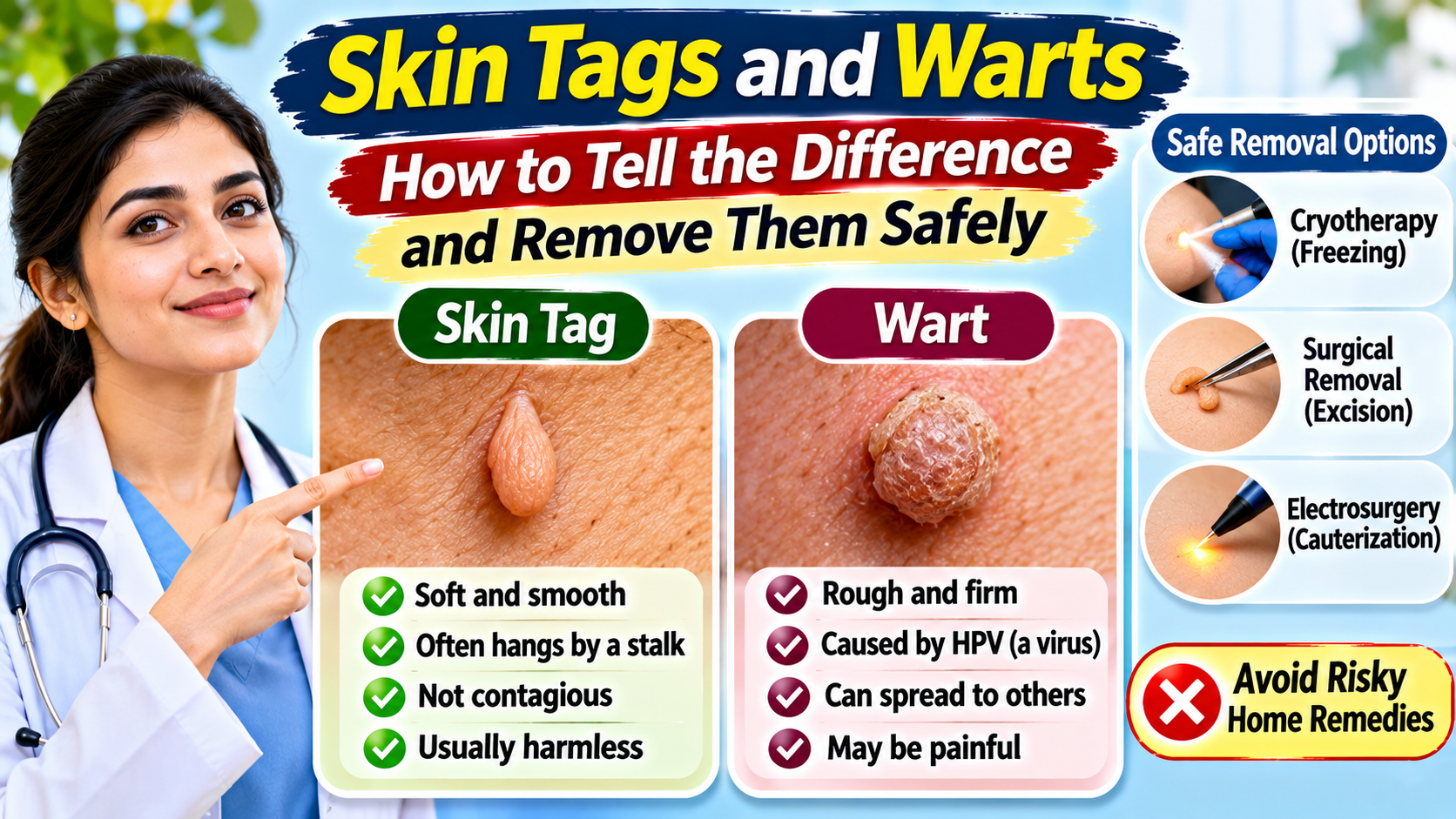
Skin Tags and Warts: How to Tell the Difference and Remove Them Safely
Have you noticed a small, soft growth on your neck, underarm, face or hands? It could be a skin tag, a wart or another type of skin condition.
Skin tags and warts are common skin growths, but they are not the same. Skin tags are usually harmless pieces of excess skin, while common warts are caused by certain types of human papillomavirus (HPV).
Many people want to remove these growths quickly, which explains the popularity of online remedies promising to make them disappear overnight. Unfortunately, some of these methods can burn, damage or scar the skin.
So, how can you tell skin tags and warts apart? What causes them? Can they disappear naturally? And what are the safest ways to remove them?
This guide explains the differences, common causes, medical treatments, home-care precautions and warning signs that should not be ignored.
1. What Are Skin Tags?
Skin tags, medically known as acrochordons, are small, soft growths that develop on the surface of the skin.
They are usually harmless and may be skin-coloured, slightly darker or pinkish. Many skin tags hang from the skin by a narrow stalk, although some have a broader base.
They commonly appear in areas where skin rubs against skin or clothing, including:
- Neck
- Underarms
- Eyelids
- Under the breasts
- Groin
- Inner thighs
Skin tags can be very small or grow larger over time. Some people develop only one, while others may have several.
Are skin tags dangerous?
Most skin tags are benign and do not require treatment.
However, they can become irritated when rubbed by clothing, jewellery or shaving equipment. An irritated skin tag may become red, sore or bleed.
If a growth changes quickly, bleeds without an obvious reason or does not look like a typical skin tag, have it examined by a dermatologist.
What causes skin tags?
The exact cause is not completely understood, but friction is believed to contribute to their development.
Skin tags are more common in people who have:
- Skin folds or areas of repeated friction
- Excess body weight
- Insulin resistance
- Type 2 diabetes
- Pregnancy-related hormonal changes
- A family history of skin tags
Having skin tags does not mean that you have diabetes. However, if you develop many new skin tags or have other risk factors for diabetes, discussing appropriate health screening with your doctor may be sensible.
2. What Are Warts?
Warts are small, non-cancerous skin growths caused by certain types of human papillomavirus (HPV).
The virus infects the outer layer of skin, often entering through tiny cuts or breaks. It can cause skin cells to grow more rapidly, producing a raised or rough growth.
Warts may appear on the hands, fingers, feet, face and other areas.
Unlike skin tags, common warts can spread from one area of the body to another and may pass between people through direct contact or contaminated objects and surfaces.
Common types of warts
Common warts: Usually appear on the fingers, hands and around the nails. They often have a rough, raised surface.
Plantar warts: Develop on the soles of the feet. Pressure from walking can make them uncomfortable or painful.
Flat warts: Small, smoother growths that may appear in groups, often on the face, legs or arms.
Filiform warts: Narrow, thread-like growths that commonly develop around the face, mouth or nose.
Genital warts: Growths in the genital or anal area caused by specific HPV types. They require appropriate medical assessment and should not be treated with ordinary over-the-counter wart removers.
3. Skin Tags vs Warts: What Is the Difference?
Although skin tags and warts can sometimes look similar, several features can help distinguish them.
| Feature | Skin Tags | Common Warts |
|---|---|---|
| Main cause | Associated with friction and other factors | Certain types of HPV |
| Texture | Usually soft and smooth | Often firm or rough |
| Shape | Often hangs from a narrow stalk | Usually raised from the skin |
| Colour | Skin-coloured, pink or darker | Skin-coloured, grey, brown or other shades |
| Common locations | Neck, armpits, groin and eyelids | Hands, fingers, feet and other areas |
| Contagious | No | Yes |
| Pain | Usually painless unless irritated | May hurt, especially on the feet |
| Natural disappearance | Usually persist | Some clear without treatment |
| Typical treatment | Clinical removal if needed | Salicylic acid, cryotherapy and other treatments |
Some warts have tiny dark dots, which represent small blood vessels. This feature may help a dermatologist identify a wart, but appearance alone is not always enough to establish a diagnosis.
Important: Not every small skin growth is a skin tag or wart. Moles, seborrheic keratoses and certain skin cancers can resemble them. If you are unsure, get the growth examined rather than trying a home treatment.
4. Can Skin Tags and Warts Disappear in 24 Hours?
The idea of removing a skin growth overnight is attractive, but it is mostly a myth when it comes to home remedies.
There is an important difference between removing a growth during a medical procedure and allowing the skin to heal afterward.
Can a skin tag disappear overnight?
A dermatologist can remove a skin tag during a short office procedure, sometimes in just a few minutes.
However, the treated area may remain red, develop a small scab or need time to heal.
Applying vinegar, garlic, tea tree oil or other household products will not reliably remove a skin tag overnight. These substances can irritate or burn the surrounding skin.
Can a wart disappear overnight?
Warts generally take longer to clear.
Some warts eventually disappear as the immune system responds to the virus. This may take months or longer.
Treatments such as salicylic acid and cryotherapy can help, but they do not normally produce complete results in 24 hours.
The time required depends on the type, size, location and number of warts, as well as the person’s response to treatment.
5. Safe Medical Treatments for Skin Tags
If a skin tag is painful, repeatedly irritated or cosmetically bothersome, a dermatologist can discuss removal options.
Common procedures include:
1. Surgical Excision
The dermatologist removes the skin tag using sterile surgical scissors or a scalpel.
A local anaesthetic may be used, depending on the size and location of the growth.
This method can remove the growth immediately, although the small wound still needs time to heal.
2. Cryotherapy
Cryotherapy involves applying a very cold substance, commonly liquid nitrogen, to freeze the skin tag.
The treated tissue is damaged and the tag may eventually fall off.
Temporary redness, blistering or changes in skin colour can occur.
3. Electrosurgery or Cauterization
This method uses controlled electrical energy or heat to remove the growth.
It may also help control bleeding during the procedure.
The appropriate method depends on the size, location and appearance of the skin tag.
Is professional skin tag removal necessary?
Not every skin tag needs to be removed. If it is harmless and does not cause discomfort, leaving it alone is usually perfectly reasonable.
A dermatologist can also check that the growth really is a skin tag before removing it.
6. Safe Medical Treatments for Warts
Wart treatment depends on the type of wart, its location, size and how long it has been present.
Some warts disappear without treatment, while others need medical care.
1. Salicylic Acid
Salicylic acid is a common treatment for certain common and plantar warts.
It works by gradually removing layers of affected skin.
Depending on the product, treatment may need to be applied regularly for several weeks or longer.
Follow the product instructions carefully. Do not apply ordinary wart-removal products to the face, genital area, moles or unidentified skin growths.
People with diabetes, poor circulation or reduced skin sensation should seek medical advice before using these treatments.
2. Cryotherapy
A dermatologist may freeze a wart using liquid nitrogen.
The treatment damages the wart tissue, which eventually sheds as the skin heals.
Several sessions may be necessary, particularly for stubborn warts.
3. Prescription Treatments
Some persistent or difficult-to-treat warts may need prescription medicines or specialist treatments.
The choice depends on the wart’s location, type and the person’s medical history.
4. Laser or Other Specialist Procedures
Laser treatment and other procedures may be considered for selected stubborn warts.
They are not necessary for every wart and may involve discomfort, scarring or changes in skin pigmentation.
A dermatologist can explain the potential benefits and risks.
7. Do Natural Remedies Remove Skin Tags and Warts?
Many online articles and videos recommend natural ingredients for removing skin growths.
However, natural does not automatically mean safe or effective.
Here is what you should know about popular suggestions.
Apple Cider Vinegar
Apple cider vinegar is sometimes applied directly to skin tags or warts because its acidity may damage skin tissue.
However, it is not a proven or recommended skin-tag removal treatment. It can cause chemical burns, irritation and scarring.
Avoid applying it to an unidentified growth.
Tea Tree Oil
Tea tree oil is promoted as a natural treatment for skin tags and warts.
There is insufficient reliable clinical evidence to recommend it for removing these growths. It can also cause irritation or allergic contact dermatitis.
Garlic
Garlic contains compounds that can irritate the skin.
Applying crushed garlic directly to a growth may cause redness, blisters or burns. It is not a recommended removal method.
Duct Tape
Duct tape has been studied as a possible home treatment for some common warts, but research results are mixed.
It should not be considered a reliable treatment for every wart, and it has no established role in removing skin tags.
Aloe Vera and Other Herbal Remedies
Aloe vera, banana peel, castor oil and similar remedies are sometimes promoted online.
There is not enough reliable evidence to show that they safely remove skin tags or warts.
The safest advice: Avoid applying household acids, garlic or harsh chemicals to skin growths. Do not cut, burn or tie them off yourself.
8. Can Warts Go Away on Their Own?
Yes. Some common warts disappear naturally when the immune system controls the virus.
This process may take months or sometimes longer.
Children’s warts often clear without treatment, although this is not guaranteed.
Other warts may persist, spread or become painful, particularly on the soles of the feet.
If a wart is not causing discomfort, a dermatologist may sometimes recommend observation rather than immediate treatment.
However, facial and genital growths, painful lesions and uncertain diagnoses should be assessed professionally.
9. How to Reduce the Risk of Skin Tags and Warts
There is no guaranteed way to prevent every skin tag or wart, but some practical habits may help.
Reducing Skin Tag Irritation
- Wear comfortable clothing that does not rub against skin folds.
- Avoid repeatedly scratching or pulling skin tags.
- Take care when shaving around raised growths.
- Keep skin folds clean and dry to reduce irritation.
- Discuss metabolic health and diabetes screening with your doctor when appropriate.
These steps may reduce irritation and address associated health factors, but they cannot guarantee that new skin tags will not develop.
Reducing the Spread of Warts
- Avoid picking, scratching or biting warts.
- Wash your hands after touching a wart.
- Do not share towels, nail clippers or razors.
- Avoid sharing footwear.
- Wear footwear in communal showers and changing areas.
- Keep warts covered when practical.
- Avoid shaving directly over affected skin.
For genital warts, follow medical advice about diagnosis, treatment and reducing sexual transmission. HPV vaccination can prevent infection from several important HPV types, including types associated with most genital warts and certain cancers, depending on the vaccine.
10. When Should You See a Dermatologist?
Although many skin tags and common warts are harmless, some growths need medical assessment.
Make an appointment if:
- You are unsure whether a growth is a skin tag, wart or mole.
- It grows rapidly or changes shape or colour.
- It bleeds without an obvious injury.
- It becomes painful, itchy or repeatedly irritated.
- It develops an open sore or does not heal.
- You have many new growths appearing suddenly.
- A wart keeps returning despite treatment.
- You have growths on the face or genital area.
- You have diabetes, poor circulation or a weakened immune system and develop a suspected wart.
Seek prompt medical assessment for a rapidly changing, bleeding or ulcerated skin growth. Do not assume that an unusual lesion is a harmless skin tag or wart.
11. How Long Does Skin Tag or Wart Removal Take?
Treatment and healing are two different stages.
Skin Tags
- Removal: A dermatologist may remove a skin tag during a single appointment.
- Aftercare: The area may be red, tender or covered by a small scab.
- Healing: The time varies according to the procedure and location.
Warts
- Salicylic acid: Often requires regular use for several weeks or longer.
- Cryotherapy: May require repeated treatments.
- Other procedures: Recovery varies according to the treatment and the size and location of the wart.
There is no guaranteed timeline for complete clearance. Follow the treatment and aftercare instructions provided by your dermatologist.
Final Verdict: Skin Tags vs Warts
Skin tags and warts may look similar, but they have different causes and require different approaches.
Skin tags are generally soft, harmless growths associated with friction and other factors. They are not contagious and can be removed by a dermatologist if necessary.
Common warts are caused by HPV and can spread through contact. Some disappear naturally, while others respond to treatments such as salicylic acid or cryotherapy.
Neither should be treated with unverified overnight remedies.
If you want to remove a growth, first make sure it has been correctly identified. A dermatologist can recommend a safe treatment and help prevent unnecessary skin damage.
Remember: removing a skin growth safely is more important than removing it quickly.
Frequently Asked Questions
1. How can I tell if a growth is a skin tag or a wart?
Skin tags are usually soft, smooth and sometimes attached by a narrow stalk. Common warts tend to be firmer, raised and rough. However, appearance alone cannot always confirm the diagnosis.
2. Are skin tags contagious?
No. Skin tags are not caused by a virus and cannot spread from one person to another.
3. Are warts contagious?
Yes. Common warts are caused by certain types of HPV and can spread through direct contact or contaminated objects and surfaces.
4. Can I remove a skin tag with apple cider vinegar?
It is not recommended. Apple cider vinegar can irritate or burn healthy skin and may cause scarring. A dermatologist can remove a confirmed skin tag more safely.
5. Can skin tags turn into cancer?
Typical skin tags are benign and do not usually become cancerous. However, other skin growths can resemble skin tags, so an unusual or changing growth should be examined.
6. What is the fastest way to remove a skin tag?
A dermatologist may remove a confirmed skin tag during an office visit using excision, cryotherapy or electrosurgery. The skin still needs time to heal.
7. What is the most effective treatment for common warts?
Salicylic acid and cryotherapy are commonly used treatments. The best option depends on the wart’s location, size and type.
8. Can warts disappear without treatment?
Yes. Some common warts clear naturally as the immune system controls the infection. This may take months or longer.
9. Can I use wart remover on a skin tag?
No. Wart removers can damage healthy skin and cause irritation, burns or scarring when used on skin tags. Get the growth identified first.
10. When should I worry about a skin growth?
Seek medical assessment if it changes rapidly, bleeds, becomes painful, develops an open sore or looks unusual. Do not attempt home removal of an unidentified growth.
Medical Disclaimer
This article is for general educational purposes only and is not a substitute for professional medical advice, diagnosis or treatment. Do not attempt to cut, burn, freeze or chemically remove an unidentified skin growth at home. Consult a qualified dermatologist for diagnosis and treatment, especially for growths on the face or genital area or lesions that change, bleed or cause pain.
References
- American Academy of Dermatology – Skin Tags: Why They Develop and How to Remove Them
- American Academy of Dermatology – Warts: Diagnosis and Treatment
- NHS – Skin Tags
- MedlinePlus – Skin Tag (Acrochordon)
- American Academy of Dermatology – Warts: Signs and Symptoms
-
National Library of Medicine – Skin Tag (Acrochordon)
2 thoughts on “Skin Tags vs Warts: Differences, Causes and Safe Removal”