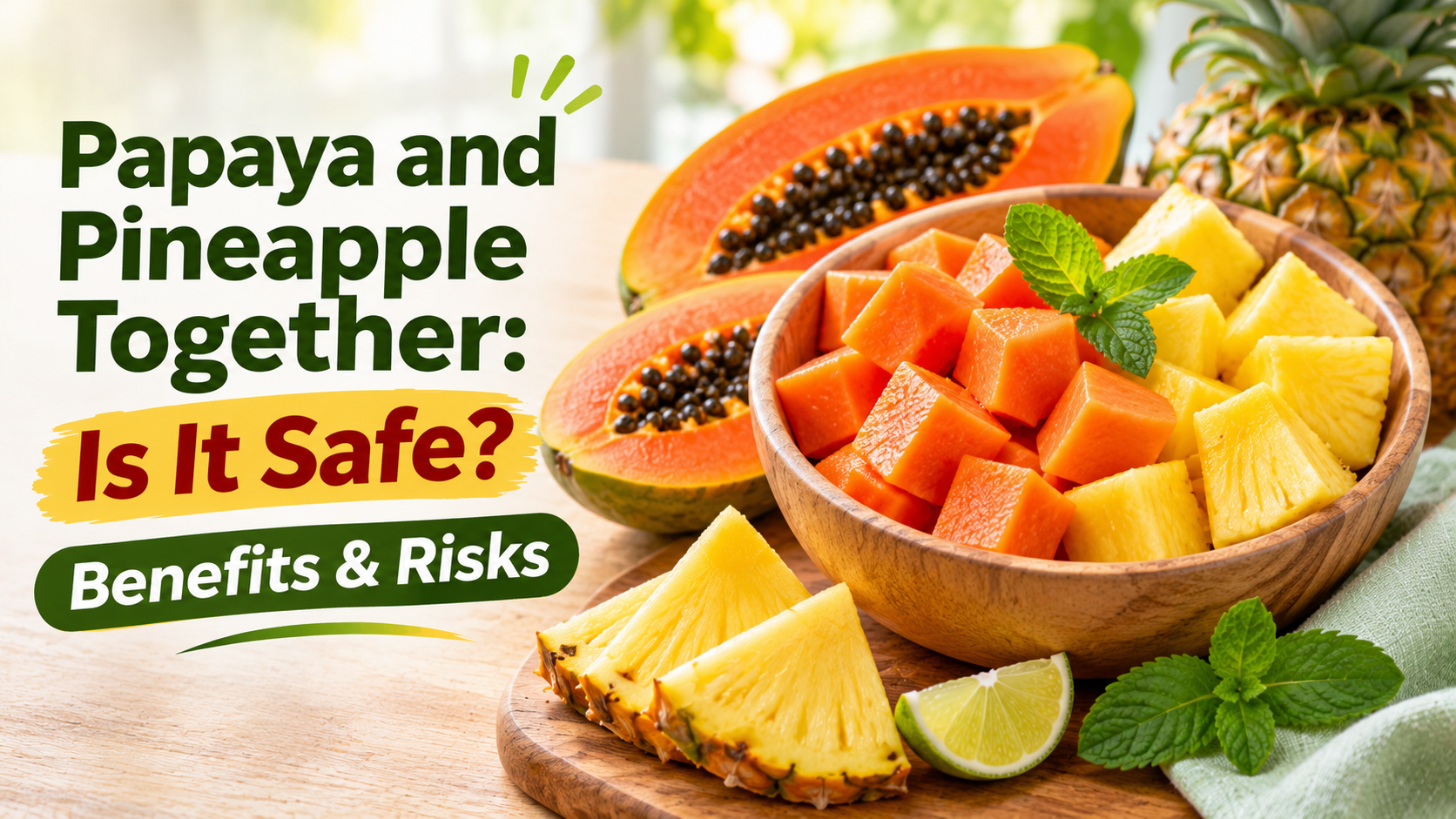
Yes, for most people it’s safe to eat papaya and pineapple together, and there’s nothing special or dangerous about the pairing. Both are low-calorie fruits that are high in vitamin C: a cup of papaya gives about 98% of the daily value and a cup of pineapple about 88%. The popular claims go further than the evidence, though. The idea that their enzymes “work together” to digest protein, cut bloating and reduce inflammation rests mostly on studies of purified enzyme supplements, not fruit. A few groups should take care: people with a latex allergy, anyone taking bromelain supplements with certain medicines, people with reflux, and pregnant women, who should avoid unripe papaya.
Table of Contents
TogglePapaya and pineapple nutrition
These are USDA FoodData Central values for raw fruit, as reported by GetFoodFacts for papaya and pineapple.
| Per 100 g, raw | Papaya | Pineapple |
| Calories | 43 kcal | 50 kcal |
| Carbohydrate | 10.8 g | 13.1 g |
| Sugar | 7.8 g | 9.9 g |
| Fiber | 1.7 g | 1.4 g |
| Vitamin C | 60.9 mg | 47.8 mg |
| Vitamin A (RAE) | 47 µg | 3 µg |
| Potassium | 182 mg | 109 mg |
| Manganese | 0.04 mg | 0.93 mg |
| Water | 88.1 g | 86.0 g |
By the cup, papaya (145 g) provides 88 mg of vitamin C, 98% of the daily value, and pineapple (165 g) provides 79 mg, 88% of the daily value.
A half cup of each (about 72 g of papaya and 83 g of pineapple) comes to roughly 72 calories, 84 mg of vitamin C, 14 g of sugar and 2.4 g of fiber. Those totals are calculated from the per-100 g values above. Papaya adds vitamin A and potassium, and pineapple adds manganese. Neither is high in fiber, and both contain sugar, so count them as fruit.
Do papain and bromelain really help digestion?
Papaya contains papain and pineapple contains bromelain. Both are protease enzymes, which means they break down protein. Cleveland Clinic lists papaya and pineapple among foods that contain digestive enzymes (Cleveland Clinic), and that part is solid chemistry. Whether eating the fruit improves your digestion is a different question, and the answer is less clear:
- Harvard Health: for most people there’s little evidence that over-the-counter digestive enzyme supplements do any good. They aren’t regulated by the FDA, so you can’t be sure how they’re made or how much enzyme they hold (Harvard Health, 2022).
- Cleveland Clinic: gastroenterologist Dr. Alison Schneider says some studies found digestive enzymes well tolerated and effective at reducing symptoms, but larger trials are needed for conditions like functional dyspepsia and IBS.
- Fruit vs. supplements: much of the research on papain has used supplements rather than whole papaya (GoodRx), so it can’t tell you what a bowl of fruit does.
- Pineapple and reflux: the NIH’s National Center for Complementary and Integrative Health says there isn’t enough research to know whether bromelain works for digestive problems, and there’s no scientific evidence that eating pineapple or taking bromelain reliably helps acid reflux (Medical News Today).
You also make your own protein-digesting enzymes, mostly in the pancreas. Cleveland Clinic’s bottom line is that in most cases you don’t need to worry about whether your body makes enough.
As for the claim that the two fruits are “synergistic” when eaten together: none of the sources reviewed for this guide tested the pair as fruit. It’s a theory, not a finding.
What the popular claims get right and wrong
| Claim | What the sources show | How strong |
| High in vitamin C | One cup of papaya has 88 mg (98% of the daily value) and one cup of pineapple 79 mg (88%), per USDA data. | Well established |
| Hydrating | Papaya is about 88% water and pineapple about 86%. | Well established |
| Less bloating, better digestion | The evidence is for purified enzyme supplements, and it is mixed and limited. No study tested the fruit pair. | Unproven |
| Less inflammation and muscle soreness | Medical News Today lists studies suggesting bromelain, an extract, may reduce inflammation and osteoarthritis pain, but says more research is needed before it is recommended for any condition. | Preliminary |
| Weight loss | Both fruits are low in calories (43 and 50 per 100 g), but none of the sources show this pairing causes weight loss. | Unproven |
Who should be careful?
Most people can eat both fruits without trouble. These are the groups that should think twice.
- A rat study in the British Journal of Nutrition found that normal consumption of ripe papaya may not pose a significant danger, but unripe or semi-ripe papaya, which is high in latex, produced marked uterine contractions and could be unsafe. The authors said more research was needed to know the risk in people (study abstract). In practice, that means avoiding green or semi-ripe papaya, including in green papaya salad, and asking your doctor about ripe papaya and pineapple. Bromelain supplements are a separate matter, and too little is known about them in pregnancy.
- Latex allergy. Some people with a latex allergy react to certain fruits because of cross-reactivity. In one study of 136 latex-allergic patients, antibodies cross-reacted with several fruits, including papaya and pineapple, and roughly 30% to 50% of people with latex allergy react to some plant foods (MDedge). Medical News Today adds that people allergic to papaya or latex are more likely to react to bromelain. If you have a latex allergy, ask an allergist before eating them.
- Bromelain may interact with anticoagulants such as warfarin and aspirin, NSAIDs, antibiotics, blood pressure medicines and some others, and Medical News Today advises checking with a doctor before taking bromelain supplements. Those warnings are about supplements. None of the sources reviewed describe interactions from normal portions of fruit, but if you take warfarin and eat large amounts regularly, tell your doctor.
- Pineapple is acidic, and some people find acidic foods make reflux worse. If you get reflux, try leaving it out and then reintroducing small amounts. Frequent reflux needs a doctor (Medical News Today).
- Sore mouth. Some people get a sore mouth after pineapple because of its acidity and enzymes. Swelling of the face or mouth, wheezing or trouble breathing is an emergency, so call your local emergency number.
- Blood sugar. A half cup of each carries about 14 g of sugar, so count it as carbohydrate if you track it, and ask your care team how it fits your plan.
How much to eat, and easy ways to eat them
There’s no official limit for eating these two fruits together. A practical portion is about half a cup of each, which is roughly 72 calories (see the nutrition section). Eat the whole fruit rather than juice, since juicing removes the fiber.
A few easy ways to eat them:
- A fruit bowl with lime and mint
- A smoothie blended with plain yogurt
- A salsa with diced papaya and pineapple, served with fish or chicken
- Fruit with yogurt or a handful of nuts. Dietitian Leslie Beck notes that combining protein and carbohydrate keeps you satisfied and energized longer (The Globe and Mail)
Choose papaya that has turned yellow-orange and is slightly soft. Green papaya is the unripe kind to avoid in pregnancy.
Two myths worth clearing up
“Never mix fruits.” This comes from the “food combining” idea that fruit should be eaten alone or it will rot in your stomach. Registered dietitian Leslie Beck points out that food combining has been tested in only one randomized trial, which found no benefit over a balanced low-calorie diet, and that your pancreas releases all of its digestive enzymes whatever you eat. She says there’s no evidence that eating fruit with other foods causes it to “rot” (The Globe and Mail). Eating two fruits together is fine.
“Papaya and pineapple cause miscarriage.” The worry traces back to the latex in unripe papaya. The animal research that exists is about unripe and semi-ripe papaya, and the same study found that normal consumption of ripe papaya may not pose a significant danger. None of the sources reviewed showed that ripe papaya or pineapple fruit causes miscarriage, but human evidence is limited, so avoid green papaya and ask your doctor about the rest.
FAQs
Is it safe to eat papaya and pineapple together?
For most people, yes. There’s nothing harmful about the pairing. Take extra care if you have a latex allergy, take bromelain supplements with certain medicines, get reflux, or are pregnant.
Can you eat papaya and pineapple during pregnancy?
Avoid green or semi-ripe papaya and bromelain supplements. For ripe papaya and pineapple fruit, ask your doctor. The animal research on papaya concerns unripe fruit, and human evidence is limited.
Do papaya and pineapple help digestion or bloating?
That hasn’t been proven. The research is mostly on purified enzyme supplements, not fruit, and Harvard Health says there’s little evidence those supplements help most people.
Can papaya and pineapple upset your stomach?
They can for some people. Pineapple is acidic and may trigger reflux, and some people get a sore mouth from it. If either happens, try a smaller portion or leave pineapple out.
Is it better to eat them raw or cooked?
Enzymes are proteins, and heat inactivates them, so cooked or canned fruit won’t give you active papain or bromelain. Since the evidence for benefits from the fruit’s enzymes is weak, that shouldn’t be what decides how you eat them.
Can I eat them if I take blood thinners?
The interaction warnings found in the sources are about bromelain supplements, not fruit. If you take warfarin or another blood thinner and eat large amounts regularly, mention it to your doctor.
Sources
- Harvard Health: Can taking enzyme supplements help soothe my bloating? (Howard E. LeWine, MD, Nov 1, 2022)
- Cleveland Clinic: Digestive enzymes 101 (with gastroenterologist Alison Schneider, MD, Sep 5, 2025)
- Medical News Today: Pineapple and acid reflux (medically reviewed by Amy Richter, MS, RD, Aug 18, 2023)
- GoodRx: Papaya enzyme benefits
- British Journal of Nutrition: Papaya consumption in pregnancy, a rat model study (abstract)
- MDedge: Beware of natural fruit and nut ingredients in latex-allergic patients (Leslie S. Baumann, MD, 2021)
- The Globe and Mail: What is food combining? (Leslie Beck, RD)
- GetFoodFacts: Papayas, raw and Pineapple, raw (USDA FoodData Central SR Legacy values, April 2026 release)
About this guide
This guide is general nutrition information, not medical advice. It doesn’t replace advice from your own doctor or dietitian, especially if you are pregnant, take prescription medication or have a food Alergy