Table of Contents
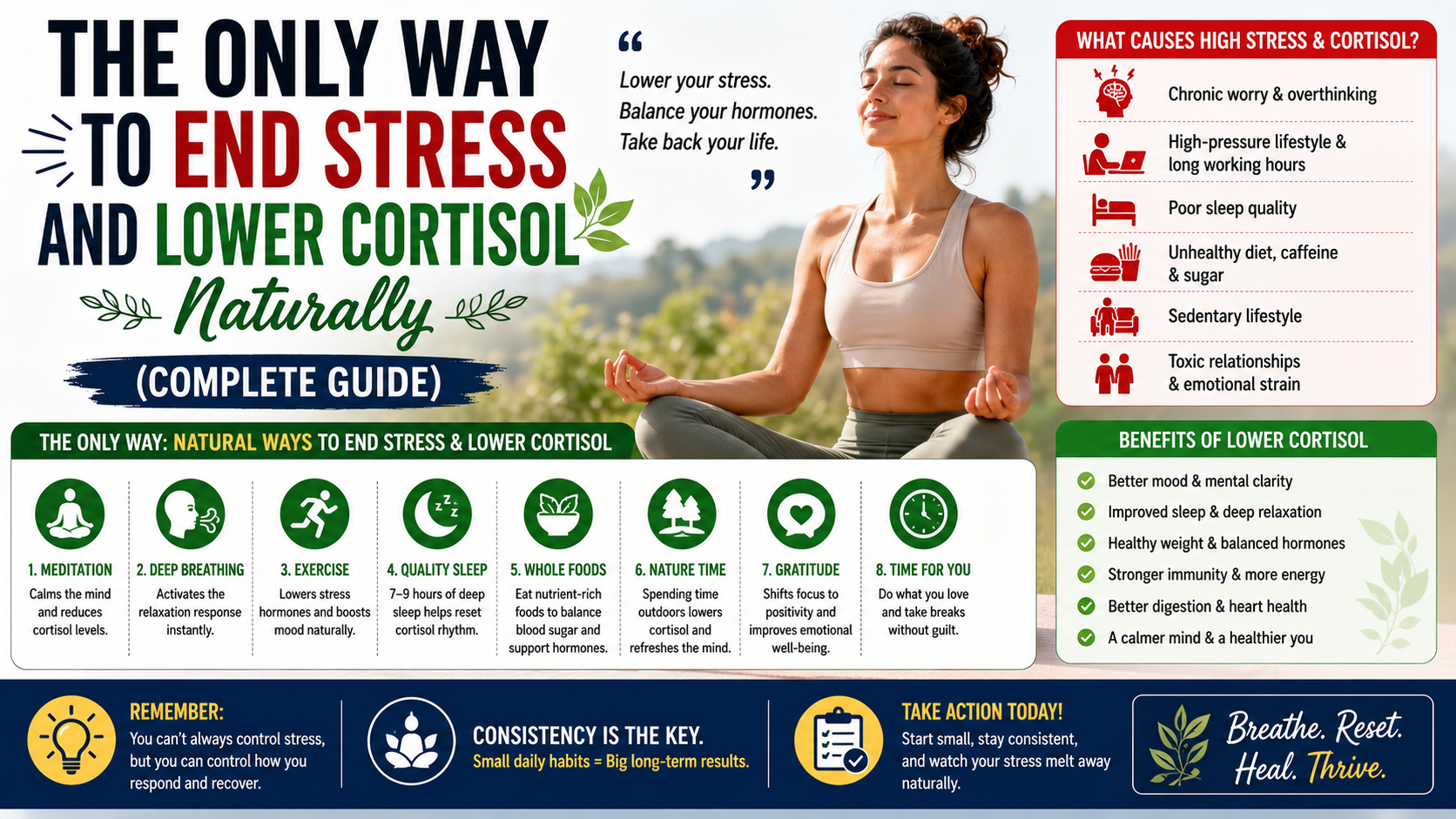
ToggleThe Only Way to End Stress and Lower Cortisol Naturally (Complete Guide)
Introduction: Understanding the Stress–Cortisol Connection
Stress isn’t just a feeling—it’s a full-body experience that can quietly shape your energy, mood, decision-making, weight, sleep, and even your relationships. If you’ve ever felt wired but tired, easily irritated, unable to relax, or constantly overwhelmed even when nothing seems “wrong,” there’s a high chance your cortisol levels are running the show behind the scenes. Cortisol, often labeled the “stress hormone,” gets blamed for everything from weight gain to anxiety, but in reality, cortisol is not the enemy. In fact, without cortisol, you wouldn’t survive. It keeps you alert in the morning, fuels your focus, and helps your brain stay sharp. The problem is chronic cortisol, the kind that stays elevated for weeks, months, or even years.
Most people don’t realize how much stress they’ve normalized. Waking up with a racing mind? Normalized. Feeling guilty for resting? Normalized. Running on caffeine and adrenaline? Normalized. Getting irritated at small things? Normalized. But your body sees these as red flags. And when the brain believes you’re under constant threat—even if the “threat” is just work emails or emotional pressure—cortisol production stays stuck in overdrive, slowly draining your internal battery. This is the beginning of burnout, inflammation, gut imbalance, sleep disruption, and emotional instability.
The modern world runs at a pace the human body was not designed for. And because of that, many people are living in a constant fight-or-flight mode without even realizing it. They try meditation apps, take supplements, or go on weekend getaways hoping stress will magically melt away, but anything that doesn’t address the root of the stress response becomes temporary relief at best.
This article explores the only sustainable, science-backed way to truly end chronic stress: regulating your nervous system so cortisol naturally returns to balance. We’ll break down how stress hijacks your brain, the subtle symptoms that most overlook, and practical steps to retrain your body to feel safe again—every day, without effort. And by the end, you’ll understand not just how to lower cortisol, but how to build a life where stress no longer controls you.
The Biology of Cortisol: How Your Body Responds to Stress
To truly understand how to end stress, you first need to understand what’s happening inside your body every time your mind senses a threat. And here’s the real kicker: your body cannot tell the difference between a real threat—like a car speeding toward you—and a psychological threat—like a harsh email from your boss. To your brain, danger is danger, and the reaction is the same. That reaction begins with a powerful system called the HPA axis, which stands for Hypothalamic–Pituitary–Adrenal axis. Think of it as your body’s internal alarm system.
Here’s how it works in simple, human terms:
The moment your brain picks up stress, it sends a crude, urgent message down to your adrenal glands—the small hormone factories sitting right above your kidneys. They immediately release cortisol, adrenaline, and noradrenaline to prepare your body for one thing: survival. Your heart beats faster, your pupils dilate, your muscles tense, and your digestive system slows down because, under threat, your body doesn’t care about digesting lunch—it only cares about staying alive. This reaction is ancient, wired into our biology from a time when “threat” meant predators and survival was a minute-to-minute challenge.
But here’s where the problem begins. In the modern world, we don’t face predators. We face deadlines, financial worries, emotional pressure, arguments, loneliness, uncertainty, and endless streams of notifications. Your ancestors might have experienced brief moments of stress followed by long periods of rest. You experience constant micro-stressors that keep your HPA axis locked in the ON position. And when cortisol gets released repeatedly without enough downtime, your system becomes dysregulated. This leads to symptoms like fatigue, anxiety, insomnia, and hormonal imbalance.
In a balanced world, cortisol rises in the morning to wake you up, then gently decreases throughout the day. But when the system is overwhelmed, cortisol spikes at the wrong times—leaving you tired during the day, alert at night, and mentally stuck. This is why learning to regulate the nervous system is so essential. You aren’t meant to live in fight-or-flight mode, and your biology can return to balance—but only when you address the deeper patterns driving stress in the first place.
The Hidden Signs Your Cortisol Levels Are Too High
Most people imagine “stress” as feeling overwhelmed or anxious. But cortisol imbalance is much sneakier than that. In fact, some signs don’t feel like stress at all—they feel like personality traits, aging, or random physical issues. That’s why so many people walk around with high cortisol without realizing their body is begging for relief.
One of the biggest signs is constant fatigue, especially the kind that doesn’t go away with sleep. High cortisol forces your body into a high-alert mode, draining your energy reserves. Over time, you might feel like you’re running on fumes no matter what you do. Another common sign is weight gain, particularly around the midsection. Cortisol not only increases appetite but also tells your body to store fat for “survival.” This is why emotional eaters often crave high-fat or sugary foods—they’re driven by biology, not lack of discipline.
Emotionally, high cortisol can show up as irritability, low patience, mood swings, or feeling on edge for no clear reason. You might snap more easily, feel overly sensitive, or find yourself worrying excessively. These emotional swings aren’t random—they come from a brain that has become hypervigilant. Sleep is also affected: high cortisol at night makes it hard to fall asleep, stay asleep, or wake up feeling rested. Many people stay awake even when they’re exhausted, simply because their nervous system doesn’t feel safe enough to shut down.
Physically, symptoms can include headaches, digestive problems, tight muscles, low libido, high blood pressure, or frequent illnesses. When cortisol is elevated, your immune system weakens, your gut slows down, and inflammation rises. Even memory and focus are affected—many people describe it as “brain fog,” forgetting words, or feeling mentally scattered.
If several of these resonate with you, it’s not your fault and it’s not a character flaw. It’s your physiology trying to cope. And the good news is: once you learn how to regulate your stress response, these symptoms can dramatically improve—sometimes faster than you think.
Why Traditional Stress-Relief Tricks Fail Most People
You’ve probably tried at least a few common stress-relief methods—meditation apps, long baths, herbal teas, journaling, deep breathing, maybe even therapy. And while these can be helpful, many people notice something strange: the relief doesn’t last. You feel calm in the moment, but the minute real life hits again, your stress response bounces right back. Why does this happen? Because these methods treat the symptoms of stress, not the source of stress stored in the nervous system.
Most traditional relaxation methods operate on a surface level. They help you feel good for a few minutes, but they don’t actually shift the patterns your body has built over years or decades. You can meditate for ten minutes, but if your body is still in fight-or-flight mode the other 23 hours of the day, the impact is tiny. It’s like trying to cool down a boiling pot by waving your hand over the steam. You might feel a slight difference, but you’re not changing the heat underneath.
Another reason these techniques fail is because people use them only during stress, instead of building a daily baseline of regulation. If you only slow down when you’re overwhelmed, it’s too late—the cortisol spike has already taken over. Meaningful change happens when you teach your body safety every day, not just during crisis moments.
There’s also a psychological barrier: many people are so used to being stressed that their brain has normalized it. Calm feels unfamiliar, even uncomfortable. If you’ve lived in high-alert mode for a long time, relaxation can feel foreign or even unsafe. In this case, surface-level self-care doesn’t work because deeper patterns in the nervous system need rewiring.
Finally, many “stress hacks” ignore the reality that stress is stored not only in the mind but in the body. Tight shoulders, shallow breathing, clenched jaws, gut tension—these are all physical signs that the nervous system is stuck in protection mode. You can’t think your way into calm if your body is signaling danger.
This is why the only sustainable way to truly end chronic stress isn’t through tricks or shortcuts. It’s through nervous system regulation, which teaches your brain and body how to return to safety—naturally, consistently, and automatically.
The Only Sustainable Way to End Stress: Nervous System Regulation
Here’s the truth most people never hear:
You don’t end stress by managing stress.
You end stress by changing the state of the nervous system that creates stress.
Cortisol rises when the nervous system senses danger. Not real danger—perceived danger. And your nervous system has learned patterns for years based on your environment, childhood experiences, habits, relationships, and even your personality tendencies. If you grew up around chaos, criticism, pressure, or unpredictability, your nervous system may have been wired for hypervigilance. If you’ve spent years multitasking, hustling, or putting yourself last, your body has learned that tension is the norm. These aren’t conscious choices—they’re automatic survival responses.
This is why nervous system regulation is the key to lowering cortisol long-term. Regulation means teaching your body what it feels like to be safe again. When your nervous system feels safe, everything changes: your breathing slows, your muscles release, your thoughts become clearer, your heart rate stabilizes, and your cortisol naturally drops. You don’t force calm. You return to calm.
Unlike temporary relaxation hacks, nervous system regulation works because it creates new neural pathways. Think of it like retraining a dog that has been bark-alert for years. You don’t quiet it by yelling at it—you train it by consistently showing it safety. Over time, the body starts recognizing that a fast email from your boss is not the same as a tiger chasing you. The system stops overreacting.
Regulation practices include breathwork, grounding exercises, somatic techniques, gentle movement, emotional processing, and lifestyle habits that signal safety to the brain. When you practice these daily, your cortisol curve shifts. Instead of spiking throughout the day, it rises naturally in the morning, dips gently in the afternoon, and lowers at night—exactly as it should.
The goal isn’t to eliminate stress completely. Stress is a normal part of life. The goal is to teach your body how to recover easily, quickly, and automatically—so stress no longer controls your mood, energy, or decisions.
Step 1: Understanding Your Personal Stress Triggers
Every person carries a unique “stress fingerprint”—a set of triggers, patterns, and emotional reactions shaped by both past experiences and current pressures. Before you can regulate your nervous system, you have to understand what sets it off. And here’s the thing: most people assume they know their triggers, but they only recognize the obvious ones—like work, money issues, or relationship conflict. The real triggers often hide beneath the surface, showing up as subtle emotional cues, old habits, or subconscious reactions you don’t even notice.
There are two categories of stress triggers: external and internal. External triggers are situations around you: noise, deadlines, arguments, clutter, time pressure, unexpected changes, criticism, or overstimulation. These are easier to spot. Internal triggers, however, are the silent ones—thought patterns, beliefs, memories, self-judgment, overthinking, fear of failure, fear of rejection, perfectionism, comparison, or the pressure to constantly perform. These triggers don’t come from the outside world. They come from how your mind has learned to interpret the world.
To identify your personal triggers, start by watching your body, not your thoughts. Your body will always react before your mind catches on. Do you feel your shoulders tightening in certain situations? Your breathing getting shallow when someone talks to you in a certain tone? Your stomach tightening before a meeting? A sudden shift in your mood with no clear cause? These are your nervous system’s early warning signs.
Another way to uncover triggers is to track your patterns. When do you feel most overwhelmed? When do you feel guilty? When do you get tired? When do you procrastinate? Stress isn’t random—it follows rules. And once you see the pattern, you can interrupt it. Journaling is incredibly helpful here, but so is simply observing yourself with curiosity instead of judgment. Most people are too busy criticizing themselves to see the deeper patterns behind their reactions.
Understanding your triggers is not about avoiding stress—it’s about recognizing the moments your nervous system needs support. When you can name your triggers, you take the first step toward breaking the automatic stress response. And once you can interrupt the cycle, you give yourself the power to respond instead of react. This awareness becomes the foundation for lowering cortisol and reclaiming control of your emotional life.
Step 2: Rewiring Your Nervous System Through Breathwork
Breath is the remote control of the nervous system. If your breath is shallow, fast, or tight, your body immediately interprets it as danger. If your breath is slow, deep, and steady, your brain receives a message that everything is safe. The beautiful thing about breathwork is that it doesn’t require thinking—your body already knows what to do. You simply have to guide it.
Most people breathe incorrectly without realizing it. Stress causes chest breathing—quick inhales that engage the upper lungs and stimulate the sympathetic nervous system (fight-or-flight). But the breath your body truly needs comes from the diaphragm—the large muscle under the lungs. When you breathe deeply into the belly, the diaphragm moves downward, signaling your vagus nerve to activate the parasympathetic nervous system, the “rest-and-digest” state. This instantly lowers cortisol, heart rate, and muscle tension.
A simple but powerful technique is box breathing: inhale for four seconds, hold for four, exhale for four, hold for four. This method is used by athletes, Navy SEALs, and trauma therapists because it quickly stabilizes the nervous system. If box breathing feels too structured, try extended exhale breathing—inhale for four, exhale for six or eight. The long exhale is the key; it tells the body to release tension.
Another method is coherent breathing, which involves taking five full breaths per minute. Studies show it increases heart rate variability (HRV), a marker of nervous system resilience. Higher HRV means you recover from stress faster and more effectively.
What makes breathwork so powerful is its ability to bypass the mind. You don’t have to convince yourself to calm down. You simply change your breathing rhythm, and the nervous system follows. Practiced daily, even for just five minutes, breathwork rewires your baseline stress response. Over time, your body learns how to return to safety more quickly and with less effort.
Breathwork is not just a technique—it’s a training tool. The more you practice, the more your nervous system remembers what calm feels like. And when your body remembers calm, cortisol naturally settles back into balance.
Step 3: Balancing Cortisol Through Daily Movement
Movement is one of the most underrated and misunderstood tools for lowering cortisol. Most people think exercise is just about burning calories or building muscle, but your body sees movement very differently. From a biological standpoint, movement is a signal of safety. When you move your body—especially in gentle, rhythmic, or enjoyable ways—you tell your nervous system, “We are not in danger.” Why? Because if you were truly under threat, your movement would be frantic, stiff, or chaotic. Calm, steady movement communicates the opposite.
But here’s where many people get it wrong: intense exercise can actually increase cortisol, especially if you’re already stressed, sleep-deprived, or burned out. High-intensity workouts, long cardio sessions, and heavy lifting can be great for a healthy nervous system—but when cortisol is already elevated, these types of workouts can push your stress hormones even higher. You might feel energized right after, but exhausted or moody later. This is your body trying to tell you it’s doing too much.
The best movement for lowering cortisol is gentle, consistent, daily movement. This includes walking, stretching, slow yoga, dancing, tai chi, mobility work, or even light strength training. Walking is one of the most powerful tools. A simple 20–30 minute walk lowers cortisol, regulates blood sugar, improves mood, and increases serotonin. Think of walking as nature’s built-in stress reset button.
Another powerful form of movement is somatic movement, which includes slow, intentional motions that release stored tension from the body. Stress gets trapped in your muscles—especially the hips, shoulders, and jaw—and gentle movement helps release these “stuck” areas. When the body relaxes, the mind follows.
The key is consistency. It’s better to move gently every day than to work out intensely a few times a week. Your nervous system loves predictability, rhythm, and continuity. When you build a daily habit of movement, cortisol starts to naturally regulate. You sleep better, digest better, think more clearly, and feel emotionally more balanced.
Movement is not about discipline. It’s about giving your body a way to process stress instead of storing it.
Step 4: Nutrition That Lowers Cortisol Naturally
What you eat directly impacts how your body handles stress. Some foods regulate cortisol, while others trigger stress signals your brain interprets as danger. The problem is that most people eat in ways that unbalance their hormones without realizing it—skipping meals, overeating sugar, drinking caffeine on an empty stomach, or relying on processed foods when they’re exhausted. But your nervous system notices everything, and your cortisol levels respond instantly.
The biggest dietary mistake people make is blood sugar instability. When your blood sugar spikes (from sweets, snacks, or refined carbs), cortisol is released to bring it back down. When your blood sugar crashes (from skipping meals or drinking coffee without food), cortisol rises again to rescue your brain. If your energy goes up and down all day, so does your cortisol. The first rule of cortisol-friendly nutrition is simple: eat balanced meals regularly—protein, healthy fats, complex carbs, and fiber.
Caffeine is another major trigger. It’s not bad in moderation, but drinking it first thing in the morning on an empty stomach spikes cortisol dramatically. The fix? Eat something small before coffee—nuts, yogurt, eggs, fruit, anything. This one change can dramatically reduce anxiety, jitters, and afternoon crashes.
Some foods naturally lower cortisol:
-
Magnesium-rich foods like spinach, nuts, pumpkin seeds
-
Omega-3 sources like salmon, chia seeds, flax seeds
-
Vitamin C from citrus, strawberries, peppers
-
Complex carbs like oats, lentils, quinoa
-
Herbal teas like chamomile, lemon balm, and ashwagandha
These nourish the nervous system and help stabilize your cortisol curve.
Hydration also matters more than you think. Even slight dehydration raises cortisol. Drinking water throughout the day is a simple but powerful way to calm the body.
Finally, emotional eating has a deeper truth: when you’re stressed, your brain craves comfort foods because it’s searching for a sense of safety. Instead of judging yourself, understand the biology—and start supporting your body with foods that give it real, lasting calm instead of temporary relief.
Step 5: Restorative Sleep and Circadian Rhythm Reset
If cortisol is the engine of the stress response, sleep is the mechanic that repairs it. The relationship between sleep and cortisol is deeply interconnected—poor sleep raises cortisol, and high cortisol disrupts sleep. This creates a vicious cycle where you wake up tired, push through the day with stress hormones as fuel, crash in the afternoon, get a second wind at night, and then struggle to fall asleep. Sound familiar? That’s not a personality trait. That’s a dysregulated circadian rhythm.
Your body is designed to follow a natural 24-hour cycle where cortisol rises in the morning to wake you up and slowly decreases throughout the day. But modern life—screens, artificial light, late-night stimulation, caffeine dependence, and constant mental activity—throws this rhythm off. When your circadian clock is misaligned, your body starts producing cortisol at the wrong times. This is why some people feel exhausted in the morning but wide awake at night. The rhythm is reversed.
Restorative sleep begins long before bedtime. One of the simplest ways to reset your circadian rhythm is morning sunlight. Just 5–10 minutes of natural light signals to your brain that the day has begun, lowering melatonin and setting your cortisol curve properly. Another powerful tool is reducing screen use 1–2 hours before bed. Blue light suppresses melatonin and keeps your brain in “daytime mode,” even though your body desperately needs to wind down.
Evening routines are essential. Activities like warm showers, gentle stretching, low lighting, soft music, and slow breathing tell your nervous system to shift into rest-and-digest mode. Avoiding heavy meals, alcohol, and intense conversations in the late evening also prevents cortisol spikes right before sleep.
Your sleep environment matters more than you think. A cool, dark, quiet room significantly improves sleep quality. Weighted blankets, blackout curtains, and air purifiers can make a noticeable difference. And if your mind races at night, keep a notebook nearby. Writing down thoughts helps your brain offload stress so it doesn’t carry it into sleep.
When you consistently support your circadian rhythm, your body naturally lowers cortisol at night, repairs your nervous system, and restores your emotional balance. Sleep becomes not just rest—but medicine.
Step 6: Mindset Shifts for a Low-Cortisol Life
Your mindset shapes your stress more than any external circumstance. Two people can face the same situation—traffic, deadlines, conflict—and have completely different cortisol responses based on their internal narrative. Stress isn’t just created by what happens to you. It’s created by what your mind believes those events mean.
The biggest mindset shift is moving from control to acceptance. Most stress comes from trying to control outcomes, emotions, timelines, people, or expectations. When things don’t go as planned, cortisol spikes. But when you shift toward acceptance—letting life unfold, trusting yourself, and releasing the pressure to manage everything—your nervous system relaxes. Acceptance doesn’t mean giving up. It means recognizing what you can control and letting go of what you can’t.
Another important shift is reframing pressure. Many people push themselves out of fear—fear of failure, fear of disappointing others, fear of not being enough. This creates chronic, internal stress even when nothing stressful is happening externally. By shifting from fear-driven motivation to purpose-driven action, you dramatically lower your baseline cortisol. Work becomes lighter. Challenges feel manageable. Life doesn’t feel like a constant test.
Self-talk plays a huge role, too. The words you say to yourself become the environment your nervous system exists in. Harsh self-criticism, catastrophizing, perfectionism, and dwelling on worst-case scenarios all trigger stress hormones. Talking to yourself with compassion—like you would talk to a close friend—activates the brain’s soothing system and helps regulate cortisol naturally.
Finally, slowing down is a mindset shift on its own. Many people live in a constant rush not because life demands it, but because their nervous system is conditioned to stay busy. When you give yourself permission to take breaks, breathe, and do things slowly, your body learns it’s safe to relax.
These mindset shifts can be subtle, but their impact is powerful. They don’t just reduce stress—they transform the way you experience life.
Step 7: The Role of Social Connection and Emotional Safety
Human beings are biologically wired for connection. From the moment you are born, your nervous system depends on cues of safety from other people—warmth, tone of voice, eye contact, supportive presence. These cues activate the social engagement system of the brain, which is directly connected to cortisol regulation. This means one of the fastest ways to lower stress is through healthy, emotionally safe relationships. Yet in the modern world, many people feel lonelier than ever, even when surrounded by others.
When you feel emotionally supported, your body releases oxytocin, often called the “bonding hormone.” Oxytocin directly reduces cortisol levels, slows your heart rate, and brings your nervous system back into balance. Even simple interactions—a kind conversation, a hug, or a supportive message—can create a biological shift. But the opposite is also true. Being around people who are critical, unpredictable, distant, or dismissive can make your cortisol spike without you realizing it. Emotional safety matters. The quality of your relationships influences your stress more than the quantity.
One powerful practice is co-regulation, which means regulating your nervous system through connection with someone whose energy feels calm, grounded, and supportive. This can be a partner, friend, coworker, or even a pet. Yes—pets count. Their presence alone can stabilize your nervous system and lower cortisol. Humans have co-regulated with animals for thousands of years.
Another aspect of emotional safety is learning to express your feelings instead of suppressing them. When emotions are held inside, they create internal pressure. This pressure becomes chronic stress. Talking things out, allowing yourself to cry, sharing your thoughts, or simply being vulnerable releases emotional buildup and signals safety to your brain. Vulnerability is not weakness—it is a biological tool for regulating cortisol.
Finally, building boundaries is essential. If you constantly give your energy away, say yes when you want to say no, or stay in environments that drain you, your nervous system is being pushed into stress mode. Boundaries are not walls. They are self-protection practices that help you stay emotionally regulated.
Social connection is not optional. It is a core component of physical health. When you nurture safe relationships, your body, mind, and hormones all respond with balance and calm.
Step 8: Creating a Daily Stress-Proof Routine
You cannot control every stressful event in your life, but you can control your daily habits—and habits shape your nervous system. A stress-proof routine doesn’t need to be complicated or time-consuming. In fact, the simpler it is, the more effective it becomes. The goal is to create predictable, soothing patterns that signal safety to your body throughout the day. Consistency builds regulation. Regulation lowers cortisol.
A powerful morning routine begins with three key elements: sunlight, hydration, and gentle movement. Sunlight sets your circadian rhythm, hydration boosts your nervous system, and movement warms up your body’s stress-response mechanisms in a healthy way. Even five minutes of stretching or walking primes your brain to handle the day with calm focus instead of anxiety.
Midday routines help prevent the afternoon cortisol dip that makes many people feel overwhelmed or exhausted. Taking a short break every 60–90 minutes, stepping outside for a few breaths of fresh air, or doing a quick body scan can reset your nervous system. These micro-breaks are more effective than long periods of rest because they prevent stress from building up in the first place. The nervous system loves frequent, gentle regulation.
Evening routines are all about winding down. A good wind-down ritual tells your brain that it’s time to relax. This could include dim lighting, soft music, stretching, herbal tea, reading, or journaling. Avoiding screens close to bedtime ensures that melatonin can rise naturally. Going to bed at a consistent time each night is one of the simplest yet strongest ways to reset cortisol patterns.
What you don’t do matters just as much. Skipping meals, overloading your schedule, drinking caffeine too late, or scrolling endlessly at night all send stress signals to your brain. When you remove these habits and replace them with calming rhythms, your body begins to function in alignment with its natural design.
A daily stress-proof routine isn’t about perfection. It’s about supporting your nervous system with small, predictable actions that build resilience. Over time, these habits become automatic—and your body learns how to stay calm almost effortlessly.
Step 9: Bonus Techniques That Rapidly Calm Cortisol Levels
Even though nervous system regulation is the long-term solution, there are also fast-acting strategies that can shift your cortisol levels within minutes. These techniques work because they communicate “safety” to the brain on a primal level. One of the most powerful tools is cold exposure—such as a cold shower, ice on the neck, or splashing cold water on your face. Cold triggers the mammalian dive reflex, which instantly slows heart rate, calms the vagus nerve, and lowers cortisol. You don’t need long sessions; even 15–20 seconds of cold is effective.
Another rapid tool is grounding, also known as earthing. When you place your bare feet on grass, soil, sand, or stone, electrons are transferred from the earth into your body, reducing inflammation and calming the nervous system. Research shows grounding can improve sleep, reduce pain, and stabilize cortisol rhythms. Even if you can’t go outside, grounding mats or simply touching natural materials can help.
Somatic shaking or “trauma release shaking” is another powerful way to clear stored tension. Animals naturally shake after stressful events to release adrenaline and return to balance, but humans suppress this instinct. Gently shaking your arms, legs, and torso for a few minutes helps release pent-up stress chemicals and stop the fight-or-flight loop.
Weighted blankets are also incredibly effective because they mimic deep pressure touch, a form of sensory input that calms the autonomic nervous system. This is especially helpful for anxiety, insomnia, and nighttime cortisol spikes. Warm baths with Epsom salt, aromatherapy, humming, and slow neck stretches also instantly stimulate the parasympathetic system.
These bonus techniques are not substitutes for deeper regulation work, but they’re powerful tools for moments when stress hits fast. They help you interrupt the stress cycle instantly, giving your body time to reset and breathe.
Step 10: Long-Term Effects of Lower Cortisol on Health & Happiness
Once your cortisol levels return to balance, your entire life changes—often in ways you didn’t expect. Physically, the body becomes more efficient. You sleep deeper, digest better, and experience fewer aches and tensions. Chronic inflammation decreases, immune function improves, and your energy becomes stable throughout the day. Because cortisol influences insulin and fat storage, you may also notice weight stabilizing, especially around the midsection.
Mentally, the fog lifts. When your brain isn’t running on stress hormones, you can think clearly, plan effectively, and stay focused without feeling overwhelmed. You stop catastrophizing small things, your memory strengthens, and your emotional resilience grows. Life feels lighter—not because circumstances changed, but because you changed.
Emotionally, you become more grounded, patient, and present. You’re not constantly reacting—you’re responding. Relationships improve because you’re not carrying silent stress, and communication becomes easier. Anxiety fades, irritability lessens, and you feel more creative, more motivated, and more confident.
Lower cortisol also influences long-term health. High cortisol is linked to heart disease, depression, hormonal imbalances, thyroid dysfunction, skin issues, high blood pressure, and premature aging. When stress settles, your risk drops significantly. You age slower—inside and out.
The greatest change, however, is internal peace. You stop rushing through life. You stop feeling behind. You stop living in survival mode. When your nervous system is regulated, joy becomes more accessible, gratitude becomes natural, and calm becomes your default setting. This is what a low-cortisol life feels like—steady, centered, and deeply alive.
Conclusion: The Path to a Calm, Balanced Life
Ending stress and lowering cortisol isn’t about eliminating every challenge or living a conflict-free life. It’s about transforming your internal state so challenges no longer shake you. When you understand your triggers, regulate your nervous system, move your body gently, nourish yourself properly, sleep deeply, build supportive connections, and create calming routines, you shift from survival mode to true living.
This is not a quick fix—it’s a lifestyle. It is the process of training your mind and body to feel safe again. And when your body feels safe, stress loses its grip. You gain clarity, energy, peace, and the ability to flow through life with confidence. Cortisol becomes your ally, not your enemy. Your nervous system becomes your foundation, not your weakness.
You deserve a life where calm isn’t rare—it’s normal. And that begins with understanding that the power to end stress has always been inside you.
FAQs
1. How long does it take to lower cortisol naturally?
Most people feel changes within 2–3 weeks of consistent regulation practices, though deeper healing can take a few months.
2. Can supplements help lower cortisol?
They can assist, but they don’t replace nervous system work. Ashwagandha, magnesium, and omega-3s are helpful but not complete solutions.
3. Why do I feel anxious even when nothing is wrong?
Your nervous system may be conditioned for stress. Anxiety often comes from stored survival responses, not current danger.
4. Is it possible to eliminate stress completely?
No—and you wouldn’t want to. The goal is not eliminating stress but teaching your body to recover quickly and not overreact.
5. Can childhood experiences affect cortisol?
Yes. Early environments shape your stress response patterns, but these patterns can be rewired with regulation techniques.
Top 10 Natural Remedies for hair regrowth….